





Digital Skills Differences Across Generations: The Myth of the ‘Digital Native’
We love to label generations with neat stereotypes, but when it comes to digital skills, do these mass generalisations actually hold up?
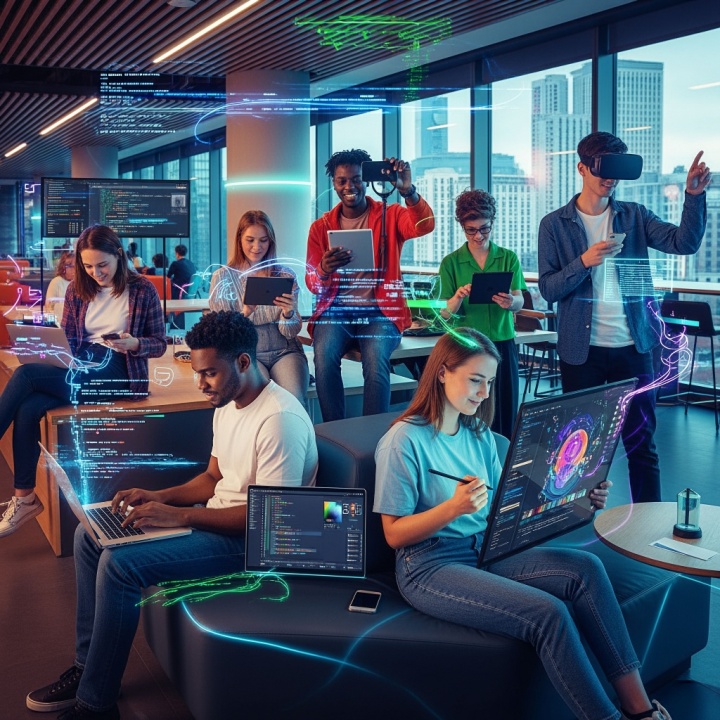
When we talk about generational differences in the workplace we tend to speak in mass generalisation. Baby Boomers are loyal and hard-working, but resistant to change. Generation X is pragmatic and independent. Millennials are collaborative but entitled. Gen Z are digital natives, effortlessly fluent in technology, but unable to communicate via other means.
One of the generalisations that begs to be questioned in this technologically advancing world is the idea of the ‘digital native.’ The idea that younger workers – those of Gen Z in particular – enter the workplace with advanced technical skills and understanding of all things digital. It may be true that this generation was raised on smartphones and social media, but that does not necessarily equate to being an Excel whizz kid.
Many employers are discovering that while Gen Z employees are highly adept at navigating apps, creating content, and communicating online, they often lack basic skills in workplace software. They need training in everyday tools like Excel, PowerPoint, and even structured email communication. These are not trivial gaps. Spreadsheet literacy underpins data-driven decision-making, while presentation skills remain critical.
In contrast, Millennials – many of whom were educated during a period when Microsoft Office was included as part of the ICT National Curriculum – often possess stronger skills in these areas. At school, they were taught to build formulas, structure presentations, and manage documents in ways that align with current workplace expectations. However, because Millennials grew up during the ‘transition to digital’ and remember a dial-up internet, pre-smartphone world, their tech understanding is perhaps more down to training than innate. This results in a more structured, systems-orientated approach to digital, which isn’t necessarily aligned with the agile, interface-orientated approach of today.
We live in a time where four, and in some cases even five, generations work alongside one another. When the Baby Boomers entered the world of work landline phones, fax machines, typewriters and filing cabinets were the technological tools of the day. In their years in the workplace, they have embraced the internet, email, cloud computing and AI. Having to adapt to constant change and continually learn new skills, has provided them with a wealth of knowledge, exceptional resilience and a real understanding of what actually makes a difference to the bottom line. They have a deep understanding of the true nature of business. Trends come and go, and the Boomers have seen them all.
The assumption, therefore, that “young equals digitally skilled” and “old equals can’t use social media” isn’t helpful – it is far more nuanced than that.
Realising that there is so much diversity of experience and education within the workforce is a huge advantage. Digital training can come from within. By recognising where digital skills strengths may lie across different generations organisations can build more effective approaches to skills development.
A Gen Z employee might teach their older colleagues about digital engagement, while a Gen X or Millennial employee can teach that same Gen Z employee how to do an X-Lookup in Excel. Meanwhile, a Boomer can sit down with that Gen Z employee and ask them to question why digital engagement matters and how it will impact the wider business.
So, returning to the original idea of the ‘digital native’? How can one generation’s experience of technology be more worthwhile than another’s? We all have something to learn and something to teach. The most effective approach is not to favour one generation over another but integrate their strengths. The combining of experience with experiment, structure with agility, adaptability with creativity, and speed with depth.